The Complete SEO Guide for 2025: Rank #1 on Google and Drive Organic Traffic
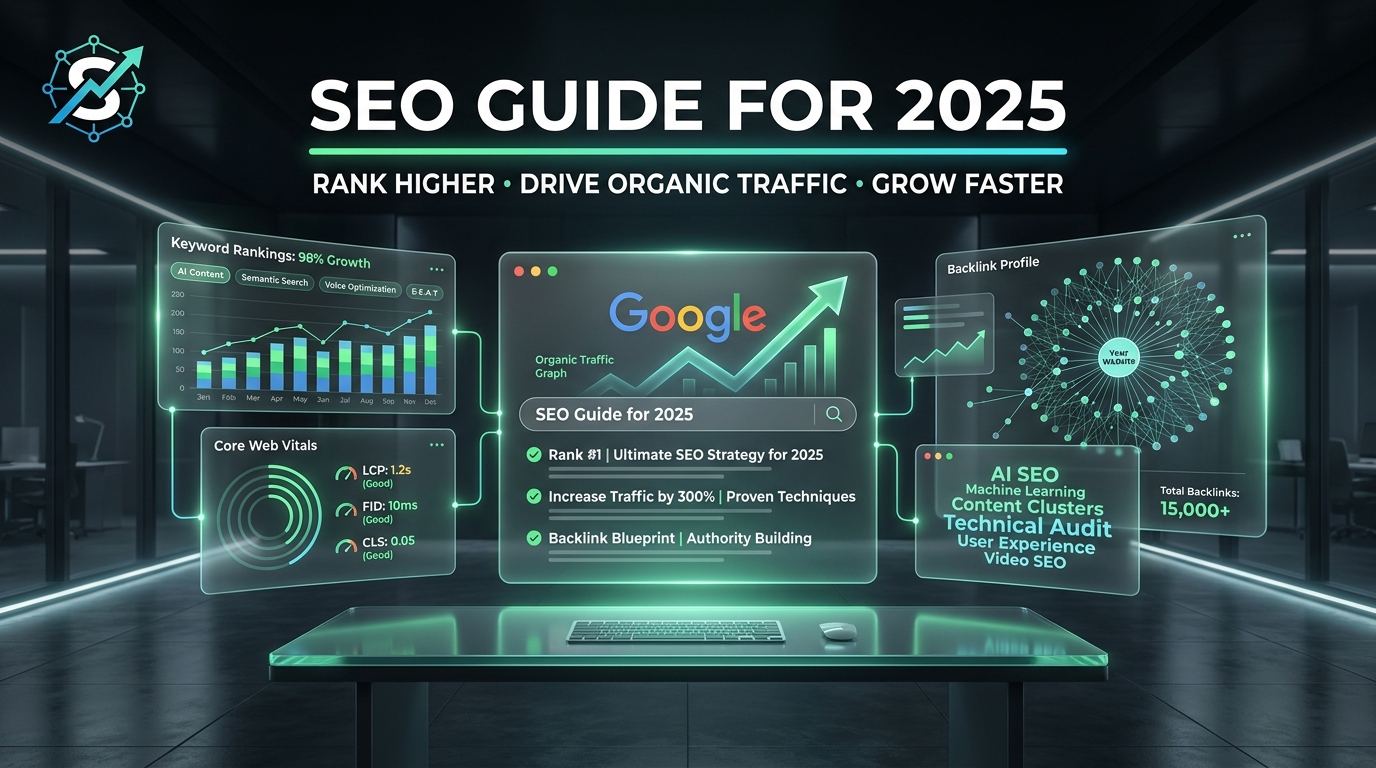
The Complete SEO Guide for 2025: Rank #1 on Google and Drive Organic Traffic
Search Engine Optimization in 2025 looks fundamentally different from what it was five years ago.Google's artificial intelligence — particularly the Helpful Content System, E-E-A-T (Experience, Expertise, Authoritativeness, Trustworthiness) framework, and AI Overviews — has completely transformed what it means to rank on the first page. This is not just about keywords anymore. It is about demonstrating genuine expertise, building real authority, and delivering measurable value to searchers.
This definitive guide breaks down every component of modern SEO, giving you a systematic roadmap to outrank competitors and capture sustainable organic traffic that converts into revenue.
Understanding Google's Ranking Algorithm in 2025
Google processes over 8.5 billion searches per day and uses over 200 confirmed(and thousands of unconfirmed) ranking signals.In 2025, the algorithm evolution is shaped by five major pillars:
- Content Quality and Helpfulness: Google's Helpful Content System rewards content created for people, not search engines. Content written to rank but providing no real value is actively demoted.
- E - E - A - T Signals: Experience, Expertise, Authoritativeness, and Trustworthiness are evaluated through author credentials, brand mentions, backlink quality, and factual accuracy.
- Core Web Vitals: Page experience signals (LCP, INP, CLS) directly influence rankings for pages competing in tight keyword spaces.
- Search Intent Alignment: Google evaluates whether your page format, depth, and content type match exactly what the searcher intended when typing the query.
- Topical Authority: Ranking a single page is less effective than dominating an entire topic cluster with interlinked, comprehensive content.
Keyword Research: Finding the Keywords That Actually Matter
Understanding Search Intent
Every keyword carries one of four intent types. Informational queries seek knowledge ("how to improve website speed"). Navigational queries seek a specific site("Semrush login"). Commercial queries compare options ("best web development agency"). Transactional queries are ready to buy("hire Next.js developer").Matching your content type to search intent is arguably the single most important ranking factor.
The Long - Tail Keyword Strategy
Long - tail keywords(3 + words, more specific) account for 70 % of all search queries yet face dramatically less competition. A new business website attempting to rank for "web development" competes with millions of pages. The same effort applied to "affordable Next.js web development agency for startups" targets highly qualified buyers with a realistic path to ranking on page one within 90 days.
Keyword Research Tools and Process
Use a combination of Google Search Console(free, shows what you already rank for), Ahrefs or SEMrush(paid, shows competitor gaps and keyword difficulty), Google's "People Also Ask" and autocomplete (reveals natural language variations), and AnswerThePublic (maps question-based keywords). The goal is to find keywords with three qualities: sufficient monthly search volume, acceptable keyword difficulty relative to your domain authority, and clear commercial or informational intent alignment with your offering.
On - Page SEO: Optimizing Every Element
Title Tags and Meta Descriptions
Your title tag is the most direct on - page ranking signal.Write title tags that: include your primary keyword near the beginning, stay under 60 characters to avoid truncation in SERPs, communicate a clear benefit or unique angle, and include your brand name when space permits.Meta descriptions do not directly influence rankings but significantly impact click - through rates — the higher your CTR relative to expected CTR, the stronger the positive ranking signal Google interprets.
Heading Structure and Semantic SEO
Use a logical heading hierarchy(one H1 containing your primary keyword, multiple H2s for main sections containing secondary keywords, H3s for sub - points).Modern SEO requires semantic keyword coverage — using related terms, synonyms, and contextually relevant phrases throughout your content. Google's natural language processing recognizes content that comprehensively covers a topic versus content that stuffs one keyword repeatedly.
Content Depth and Comprehensive Coverage
The "skyscraper technique" remains valid: identify the highest - ranking content for your target keyword and create something demonstrably more comprehensive, more current, more visual, and more valuable.In competitive niches, ranking on page one typically requires 2,000 + words of genuinely useful content, multiple visual aids, original data or research, practical examples, and a format optimized for the specific intent(step - by - step guides, comparison tables, calculators, etc.).
Technical SEO: The Foundation Everything Else Builds On
Website Architecture and Crawlability
Search engines must be able to efficiently crawl and index your entire site.Key technical requirements include: a logical site structure where all pages are accessible within 3 clicks from the homepage, an XML sitemap submitted to Google Search Console, a well - configured robots.txt file, consistent canonical tags to prevent duplicate content issues, and HTTPS security across all pages.
Core Web Vitals Optimization
Achieving "Good" scores on Core Web Vitals requires specific technical interventions:
- LCP optimization: Ensure your largest above-the-fold element loads within 2.5 seconds. Use preload hints for hero images, optimize image formats to WebP/AVIF, implement a CDN, and defer non - critical JavaScript.
- INP optimization: Minimize main thread blocking. Defer heavy JavaScript, use web workers for complex computations, and implement code splitting to reduce execution time.
- CLS optimization: Reserve space for images and ads with aspect-ratio CSS, avoid injecting content above existing content, and load custom fonts without layout shift using font-display:optional.
Structured Data and Rich Results
Schema markup communicates your content's meaning directly to search engines, enabling rich results (star ratings, FAQs, How-To steps, Product prices) in SERPs. Rich results have CTR advantages of 20–30% over standard blue links. Implement JSON-LD schema for Article, Product, LocalBusiness, FAQ, and BreadcrumbList based on your content types.
Link Building in 2025: Quality Over Quantity
Backlinks remain a top - three ranking factor.However, Google's link spam algorithms have made toxic and low-quality link building actively harmful. In 2025, effective link building means:
- Digital PR: Publishing original research, industry surveys, or data reports that earn natural citations from journalists and bloggers in your industry.
- Expert commentary: Contributing quotes and expert perspectives to industry publications (HARO, Connectively).
- Broken link building: Finding broken outbound links on high-authority sites and offering your superior content as a replacement.
- Guest content: Writing genuinely valuable articles for authoritative publications in your niche in exchange for a contextual backlink.
- Resource page link building: Getting listed on curated resource pages relevant to your industry and region.
Local SEO: Dominating Your Geographic Market
For businesses serving local customers, local SEO drives the highest - intent traffic.Optimize your Google Business Profile completely(all categories, photos, services, opening hours, Q & A).Build consistent NAP(Name, Address, Phone) citations across directories.Earn Google reviews consistently — the quantity and recency of reviews directly influences local pack rankings.Create locally optimized service pages with city and region - specific content addressing local customer pain points.
Measuring SEO Success: Key Metrics and Tools
Track the right metrics to demonstrate SEO ROI: Organic sessions (total and by page), Keyword rankings (particularly page - one rankings and keywords moving from page 2 to page 1), Organic CTR (benchmark against industry averages), Backlink growth (domain authority and new referring domains), Conversion rate from organic traffic (the ultimate business metric), and Core Web Vitals scores in Google Search Console.
Frequently Asked Questions About SEO
How long does SEO take to show results ?
For a new website in a competitive niche, expect meaningful results in 6–12 months.For established sites with existing authority targeting new keywords, rankings often improve within 60–90 days of on - page optimization.Technical SEO fixes can show Search Console improvements within days of Google recrawling your site.
Is SEO still worth it with AI Overviews ?
Absolutely.While AI Overviews reduce clicks for simple informational queries, they increase clicks for complex, multi - faceted topics where users want to explore deeply.Furthermore, organic ranking on page one of Google still delivers click - through rates of 25–40 % for position one, representing the most cost - effective source of high - intent traffic available to any business.
Dominate Your Market with Expert SEO
Our SEO specialists have driven first - page rankings for clients across industries, generating millions in attributable organic revenue.From comprehensive technical audits to content strategy and link building campaigns, we build SEO programs that compound in value month over month.
Request your free SEO audit today and receive a prioritized action plan for your highest-impact ranking opportunities.