Why UI/UX Design Is the Backbone of Every Successful Digital Product
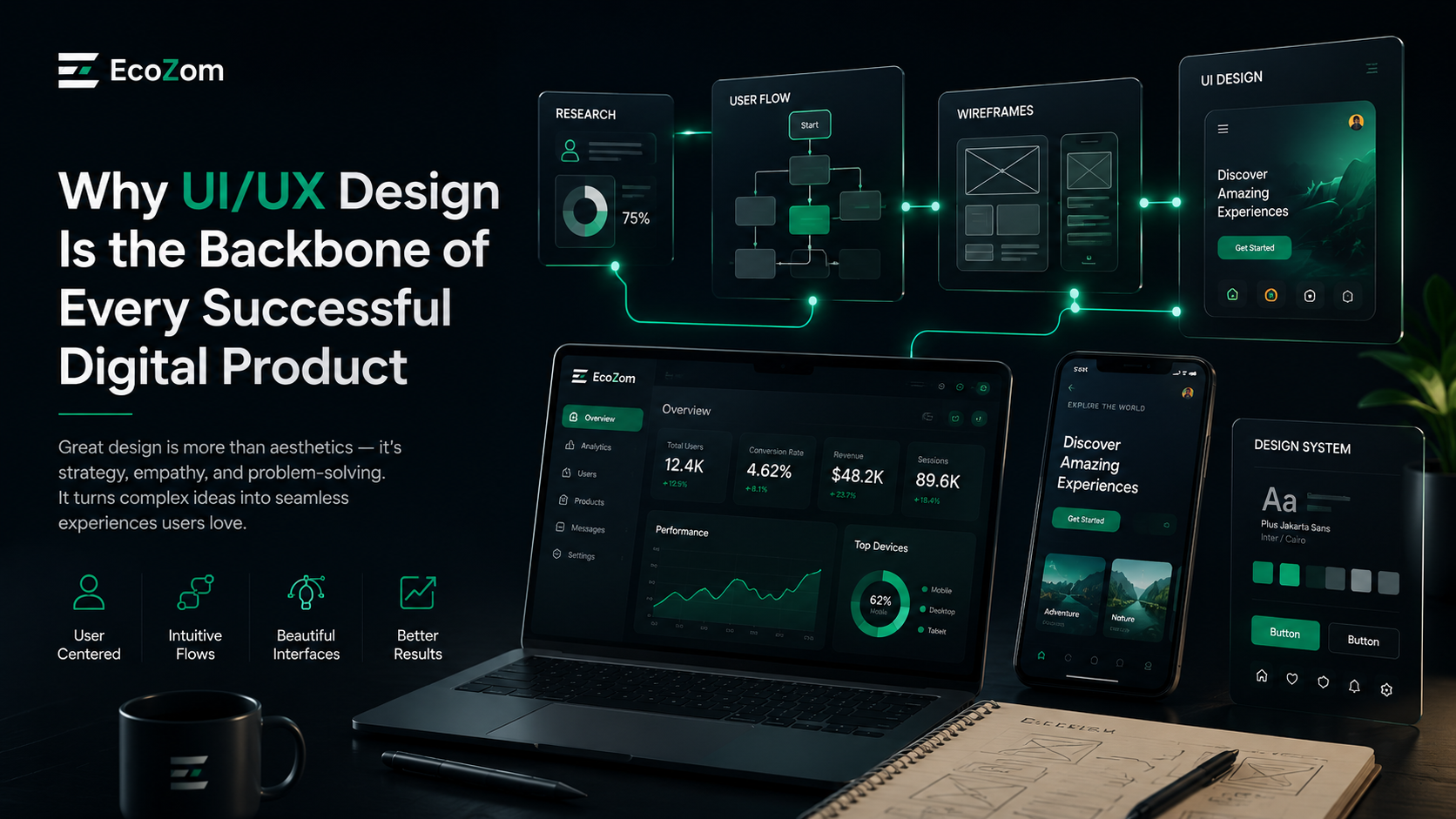
Why UI/UX Design Is the Backbone of Every Successful Digital Product
In a world flooded with apps and websites, the difference between a product that grows and one that gets abandoned often comes down to one thing: design. Not just how it looks, but how it works, how it feels, and how naturally it guides users toward their goals.
At EcoZom, design is never an afterthought. It is the foundation we build everything on — because a product that users do not understand or enjoy using will fail, regardless of how powerful the technology behind it is.
What Is UI/UX Design, Really?
UI stands for User Interface — the visual layer users see and interact with: buttons, colors, typography, layouts, icons, and animations. UX stands for User Experience — the strategic layer that governs how the entire interaction feels, flows, and resolves. The two are inseparable. A beautiful UI built on a broken UX creates frustration. A logical UX wrapped in a poor UI loses trust instantly.
Why Design Directly Impacts Business Results
Design is not a creative luxury — it is a measurable business driver. Every element of your product's interface influences how users behave, whether they complete an action, return to the product, or recommend it to others.
- First impressions form in 0.05 seconds. Users judge the credibility and quality of a product almost instantly. A poorly designed interface communicates carelessness before a single word is read.
- Bad UX increases drop-off rates. Confusing navigation, unclear calls to action, and poor information architecture push users away at every stage of the journey.
- Good design increases conversion rates by up to 200%. When users find what they need easily and feel confident in the product, they convert — whether that means signing up, purchasing, or contacting your team.
- Retention is a design problem. Products that users return to are products that feel effortless. Design-driven products build habits, loyalty, and long-term growth.
Our UI/UX Design Process
1. Research & Discovery
Before designing a single screen, we research the target audience, the competitive landscape, and the business goals. Understanding who the users are and what they truly need is the foundation of every design decision we make.
2. User Flows & Information Architecture
We map out every path a user might take through the product. Where do they land first? What do they need to accomplish? What friction points exist? Solving these questions before touching design tools saves weeks of rework later.
3. Wireframing & Prototyping
We create low-fidelity wireframes to establish structure and logic, then build interactive prototypes that simulate the real product experience. This allows stakeholders to test and validate ideas before a single line of code is written.
4. Visual Design
With structure validated, we apply the visual layer: typography systems, color palettes, spacing rules, component libraries, and motion design. Every visual decision is intentional and tied directly to the product's brand identity and user expectations.
5. Handoff & Design Systems
We deliver clean, developer-ready design files with organized component libraries and documented design systems. This ensures development stays consistent and fast, and that future iterations remain coherent.
Common Design Mistakes That Kill Products
- Designing for aesthetics instead of function
- Ignoring mobile users and responsive behavior
- Using too many fonts, colors, or visual elements
- Building without user testing or feedback loops
- Treating design as the last step instead of the first
- Inconsistent components that confuse users across screens
Design as a Competitive Advantage
In saturated markets, design is often the only differentiator. Two products with identical features can have completely different outcomes based purely on user experience. Companies that invest in design from the beginning build products that are easier to use, easier to market, and easier to grow.
The most successful digital products in the world — from Airbnb to Notion to Linear — share one thing: they are designed with obsessive attention to how users think and feel.
What This Means for Your Product
Whether you are building a new SaaS platform, an e-commerce experience, a mobile application, or a marketing website, design is not optional. It is the layer that connects your technology to your users — and ultimately, to your revenue.
At EcoZom, we approach every project with design thinking at its core. We do not just make things look good. We make them work in ways that create real, measurable impact for businesses and their users.
Conclusion
UI/UX design is not decoration. It is strategy. It is empathy. It is the discipline that transforms a functional product into one that people love, trust, and choose over the competition. Invest in design from day one, and your product will thank you at every stage of growth.